
Groupon – Back to Crazy Company Valuations

Just when I thought we were finally over the craziness of obscene IT company valuations of the 2000 dot com bust, I see Groupon’s latest valuation. $15 billion dollars for Groupon? That insanity! And although Groupon isn’t the only one getting ridiculous valuations, it’s definitely one of the worse along with Facebook’s $50 billion valuation from Goldman this month.
So let’s look at some numbers. And I’m not even yet talking about revenues or financials, let’s just look at the recent valuations. There’s no way the company’s growth is in line with the growth of its valuations.
In April 26, 2010, it was valued at $1.2 billion. This is when they said they expected to make $100 million for 2010. Shortly after this, Google offered Groupon somewhere between $5 billion to $6 billion, which they turned down. This month, based on their latest financing round of $950 million, Groupon has a valuation of $15 billion. Yes, that’s right $15 billion!
All this from a company that was spun off as recently as 2007, that only really started its web presence in late 2008. Now I’m not saying you can’t make large amounts of money in that amount of time, but creating $15 billion dollars of value, it’s not very likely.
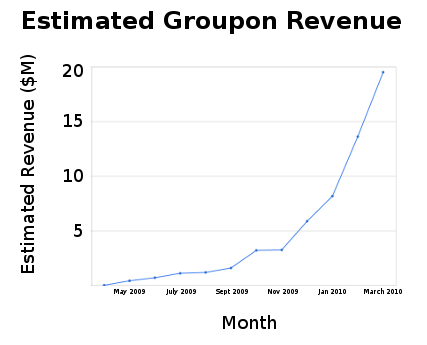
But before I get too ahead of myself, let’s look at some concrete numbers, just to make sure I’m not the one who’s out to lunch here. Initially Groupon estimated it would make $100 million for 2010. It now appears that this number needs adjusting and they will claim upwards of $350 million in revenues. This is really good news, and it does explain why there’s so much hype for this company. My congratulations to Groupon for that kind of growth, it’s amazing!
But before we get ahead of ourselves, we need to realize that not all of Groupon’s revenues is theirs. Remember that Groupon has to pay up to 50% to the merchants. That means that their real revenues are probably closer to $150 million. In other words, the stated revenues are highly inflated, because although it’s revenues it’s not really real revenues. Unfortunately that’s going to help them get better valuations, especially if they become a publicly traded company. Most people just aren’t going to take the time to determine exactly how a company earns it’s revenues, they just quickly look at the numbers (if that, many just go with brand names or the hype associated to the a company). If you’re interested in more detailed analysis of Groupon’s revenues, Paul Butler has written a really good article. His analysis is pretty thorough and I agree with his findings.
In any case, ignoring the issues with actual revenues, if you graph those revenues based on the available information, you get a revenue graph that pretty amazing (see below – source: Paul Butler). The growth curve is definitely something to write home about!
But even with that kind of growth, are the valuations worth it? Can it sustain that growth over time? Will the growth slow as the company grows? The bigger a company gets, the harder it is to maintain high growth levels. It’s much much easier for a $1 million dollar company to double in size than a $1 billion company. How often do $100 billion dollar companies double in size?
But most importantly, what is the premium paid for that growth today? In other words, how long do they have to continue that growth to get a reasonable valuation?
The best way to find out is to calculate the premium, for example using metrics such as P/E, and even that won’t really work because we don’t have enough information about Groupon (it’s a private company). But let’s go ahead and do a close enough comparison anyways, let’s do a P/R (Price / Revenue). Assuming my numbers are correct, that’s a P/R of about 43 based on total revenues. However if I make an adjustment to use their real revenues, the P/R skyrockets up to about 100.
Although we can’t do an accurate P/E calculation, we can do a quick ballpark calculation. Assuming 50% of that revenue goes to the merchant, we’re left with $175 million of revenues to make a profit from. Assuming another 50% for operating expenses (meaning a 50% profit which is very high and generous), that leaves us with $87.5 million in profits. Therefore as a quick ballpark, we’re looking at a P/E of 171 for Groupon!!! Is it just me, or is this P/E value all too reminiscent of the Dot Com Boom and Crash of 2000? And that’s just one metric. By the way, if we use a 35% cut rather than a 50% cut for the merchant, we still get a P/E calculation of 132. This is just as insane as 171.
And if metrics aren’t your cup of tea, maybe we can do direct comparisons of Groupon to existing companies with similar market valuation? Here’s a small list of companies valued similarly to Groupon.
| Company | Valuation | Revenues |
|---|---|---|
| Adobe | $17.03 billion | $3.8 billion |
| Best Buy | $13.93 billion | $49 billion |
| Staples | $16.83 billion | $24.2 billion |
| Symantec | $13.83 billion | $5.98 billion |
| McGraw-Hill | $11.54 billion | $5.95 billion |
| Groupon | $15 billion | $0.350 billion |
Do you know what the first thing I noticed in this list, not one of these companies has revenues below a $1 billion other than Groupon, or even several billion! Although I have to admit I haven’t done the most thorough search, I don’t think you’ll find many, if any, stocks with these kinds of valuations in the public market. The numbers just don’t make sense.
The premium on Groupon is such that you’re paying for it as though it’s already a very large and mature company. That is, the built-in premium on the company is so large that it would have to continue the same level of growth for at least a decade or more. The odds against that are extremely low.
I also believe every single company on the list above is worth more than Groupon. But don’t take my word for it, let’s look at another comparison. Let’s look at the valuation to revenue ratios. From our list above, the best (largest) ratio (other than Groupon) is from Adobe at 4.48. Groupon’s ratio is 42.85! That’s 10 times more than the best ratio on that list. If you can find a company that has even close to that ratio, that’s listed on either the Nasdaq or NYSE, then please let me know!
Using the 4.48 ratio, which is the best ratio (highest premium), that would make Groupon worth $1.5 billion. If we use the lowest ratio (Best Buy with a 0.28 ratio) that would make Groupon worth $98 million. Which means that Groupon should be valued anywhere from $100 million to a max of $1.5 billion according to this list. I agree the sample size isn’t very large, but this is a fairly common sample of companies at these valuations. As you get to valuations of this scale, the premiums start to diminish. It’s understandable for smaller companies that can grow faster, but at these scales it’s much more difficult to get similar growth rates for larger companies.
Anyways, do any of these companies really compare to Groupon in terms of value? If someone gave you the option of getting $x of stocks in only one of these companies, and you had to wait at least 3, 5, or even 10 years to sell, which company would you select? Is Groupon worth 10 times as much as those companies? I personally don’t think so. Do you?
Permalink to this article Discussions (1)
Common Wisdom Isn't Always Right

Today’s post is going to be very different than my normal posts, I’ve decided today to write about a random observation I made some time ago. Which leads me to the main topic of this post, and that is to question what we take for granted. Just like in my previous post where I suggest that having a job is NOT necessarily safer than being an entrepreneur, today I’m going to give you another example why it’s important NOT to take conventional wisdom as fact. Especially as an entrepreneur!
Conventional wisdom says that violent video games cause people to become more aggressive and violent. And if you think about it, it does seem to make sense on the surface of things. But is it really true? Sure there are examples of people who played violent games that did become violent, but I’m sure I can find examples of people that are into other very non-violent activities and hobbies that did just as violent things. I will wager that somewhere there is a quiet and shy librarian or butterfly collector that has had some kind of violent outburst.
The question isn’t if there are examples because you can find examples for just about anything, especially with the internet and YouTube these days. I can probably find several examples of people that lost their pinky finger and have made more than a million dollars starting their own business. I’m sure I can find examples of people who purchase DVD players in December that have are balding prematurely. You can almost always find at least one or two examples of anything if you look hard enough. Just because there is an example doesn’t mean it’s related.
The bigger question is if there’s a correlation. Once we have a correlation, we can then investigate if there’s a causation. For example, as the number of pirates have decreased, there has been an increase in global warming over the same period. Therefore is the lack of pirates is the cause of global warming? Since the 1950s, both the atmospheric CO2 level and crime levels have increased sharply therefore CO2 causes crimes. In both of these cases it’s obivous that there is a correlation but it’s also obvious that the correlation doesn’t causation. That is to say that one cased the other.
Back to our question, do video games actually make you more violent?
But before we answer that question, let’s look at sports. Do sports make you more violent? Or more precisely does watching sports make you more violent? Conventional wisdom here would say no, that watching sports shouldn’t make you any more violent. How could watching sports make you more violent? If anything it would make you less violent than playing sports.
Let’s be even more specific, since sports can include a lot of different sports, some more violent than others. Can watching football make you more violent? What about basketball or hockey? What about soccer?
If you answered no, then let me ask you another question. Why was there such a police presence at the World Cup? Why were they needed? Why were they prepared long in advance? Why is that after most major championship games there’s generally a strong police presence? Why are they almost every time? Why are the fans so violent after the events? In other words, why are there riots after many major sporting events?
With that in mind, let me ask you this. Was there a police presence at the E3 Expo (Electronic Arts Expo)? This is after one of the biggest, if not the biggest, gaming event in the world. The one where all the biggest game titles are released. Where people get to try and play the latest games. The one with an attendance of over 45,000 people.
If video games have a tendency to cause people to become violent, shouldn’t there have been at least one major incidence? One riot? Shouldn’t there at least be some police presence? In the 10 plus years of the event, and correct me if I’m wrong, I’ve never heard of any major issues with violent outbreaks. I’ve never heard of the event requiring any kind of police presence beyond what’s standard at events of that size.
Which leads me back to my original observation and question, do video games make people violent? If your answer is still yes, then I cringe at what watching sports events do to people.
So if someone ever tells you that’s how you should run your business because that’s just how it’s always done and everybody does it that way, don’t assume it’s always right.
Permalink to this article Discussions (1)
Entreneurship is Safer Than a Job

Many people will argue that a job is much more reliable and safer than being an entrepreneur, but they’re wrong! The worse part is that they’ve never really taken more than a second to actually look at the differences, they just assume it’s better. The reality is different. Do you remember that old saying “don’t put all your eggs in one basket”? Well we’ll get to that shortly, but in the meantime just remember that a job means you’re putting all your financial revenues in one single basket, your employer.
But before that, let me give you an example of just how unsafe a job really is. Have you ever been laid off? Has your project ever been terminated early? Have you ever worked for a company that’s been downsized? How about a company that’s closed? What about a company that closes down your department? A company where the business model no longer works? A company that closes your location?
And it’s not just at the company level, what about on a personal level. Have you ever worked with a difficult boss? What happens if you make a bigger mistake one day? What happens if you get sick? What if your boss is not a good person? What about co-workers? The list goes on.
With a job it’s generally you have a job or you don’t have a job. It’s on or off. You don’t have a partial job, you have one or you don’t have one.
An entrepreneur however isn’t so black or white, it’s more of shades of gray. In other words it’s rarely one or the other. You generally have some revenues, some customers. The company makes some money. Unless something catastrophic happens, which affects both the employee and entrepreneur the same way, you generally see an incline or decline in revenues over time. It’s not overnight. You don’t come in one morning to see your business completely come to a complete halt without any warning.
In other words, as an entrepreneur you don’t have all your eggs in one basket. You have multiple clients, they’re just called customers, whereas as an employee you have only one customer, your employer. If you lose that one customer, you have nothing. Zilch. Nada. The big goose egg. It’s over. As an entrepreneur a single loss of a customer isn’t nearly as catastrophic as it is for an employee. Not that you want to lose customers, but the difference is that not everything is tied to one and only one customer.
So let me ask you again, which is safer, being an entrepreneur or being an employee?
Permalink to this article Discussions (2)
Are Shorter Headlines Always Better?

It’s generally assumed that shorter headlines are better. Not just a little bit better but significantly better. The reality is that it’s necessarily not true. Shorter headlines are indeed better, but just marginally better. The difference between a 3 word headline and a 13+ word headline is not even 10%!!
A study of 2500 ads done in 1939-1940 by Harold J. Rudolph through the Saturday Evening Post found that the content of the headline is the major element that determines the effectiveness of a headline, not it’s length as is generally assumed. The table below shows the difference in the number of people who read the headline based on the number of words in the headline:
.
| Number of Words in Headline | Percentage of People who Read the Headline |
|---|---|
| Up to 3 | 87.3% |
| 4-6 | 86.3% |
| 7-9 | 84% |
| 10-12 | 82.5% |
| 13+ | 77.9% |
Therefore what we should learn from this is that if you have to add extra words, do so as long as it makes your ad more effective. A shorter headline with poorly chosen words is not as good as a longer headline with well chosen words. After all the difference in effectiveness isn’t even a full 10%. It’s definitely not as much as we’re generally lead to believe.
Permalink to this article Discussions (2)
How Accurate Were My 2009 Google Trend Predictions?
For those of you who aren’t familiar with Google Trends, it is a free service by Google that lets you determine the trend of different keyword searches over time, and ultimately compare them against together. This is extremely powerful in that it can really help you predict the future, in many cases it’s so accurate that it can be scary! So today I’m going to take the time and revisit my predictions from June 8, 2009 (about a year and a half ago) when I wrote Can Google Trends Predict the Winner? In case you’re wondering, the answer is yes it can. It’s that accurate!
So let’s look at each prediction one by one to see what’s happened since:
LCD TV versus Plasma TV (obvious prediction)
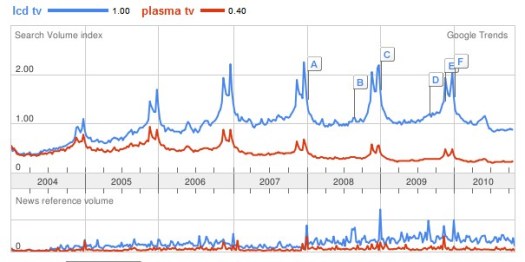
In 2009 I predicted that plasma TV’s were on their way out. Clearly this trend is continuing today.
MySpace versus Facebook (scary good prediction)
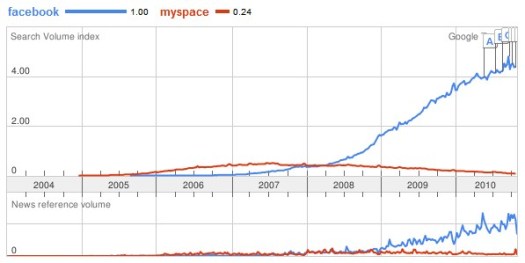
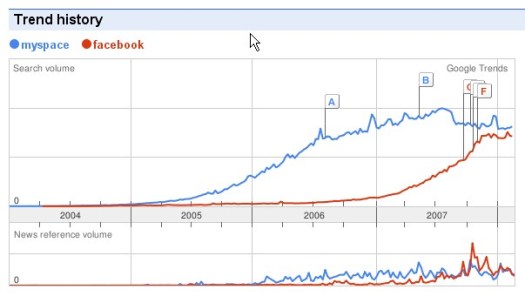
This is one of my favorite predictions, partially because I predicted this as far back as 2007 when Facebook and MySpace were neck in neck, when there was no clear winner yet. When I initially wrote my ebook How to Generate Traffic For Your Website I used the example with data up to early 2008 (first edit). When I re-edited it in 2009, I kept the same graph (shown below) because it was even less clear who the winner was going to be. By 2009 it was starting to become pretty obvious. Of course today there’s absolutely no doubt.
Netflix versus BlockBuster (scary good prediction)
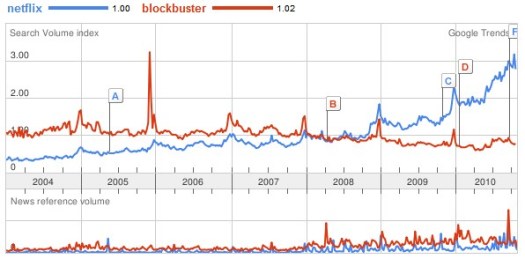
By mid-2009 you could see a downward trend for BlockBuster and an upward trend for Netflix. Based on that, I predicted that Netflix would win over BlockBuster. I used BlockBuster because it was the biggest movie rental company by a large margin.
It turns out that prediction was all too accurate. In September of this year (2010) BlockBuster filed for Chapter 11 Bankruptcy protection. And Netflix is showing no signs of slowing down, they’re actually showing some pretty solid growth as shown below:
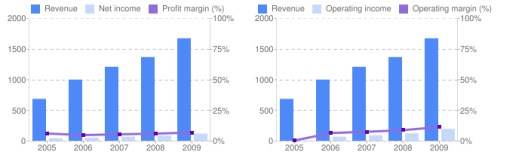
In case you’re wondering, how could you have leveraged this information and made money from it. Well the answer is pretty easy. For one you could have avoided losing (er I mean investing) any money in BlockBuster stocks and bought Netflix stocks instead.
For example, if you invested $1000 in Netflix in June 2009, you would’ve paid about $40/share, acquiring 25 shares. Today those same 25 shares would be worth $168.15 each, giving you a total of $4,203.75. A handsome profit of $3,203.75!! You would have made 400% on your money!
If you had invested that $1000 in BlockBuster, at the going price of about $0.65 a share in June 2009, you would now have a total share value of $107.69. You would have lost of the tidy sum of $892.31! In other words you would’ve almost all of your money!
Of course this is a drastic example, for sure not all predictions are that drastic. But it sure does make me think, especially when almost all of my predictions using Google Trends turned out true!
Tivo versus PVR versus On-Demand (ok prediction)
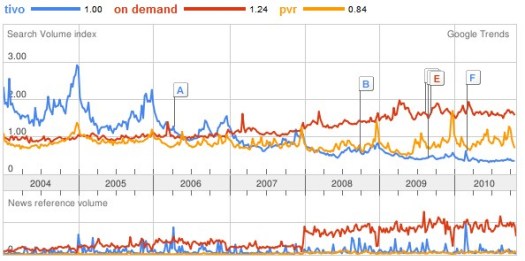
Although harder to see because the changes aren’t as drastic, my predictions from a year and a half ago appear to have also come true here as well.
Tivo continues to be on the decline. In terms of investments, it doesn’t quite work out. It just happens that Tivo had an upswing in stock price in June 2009, going from $7 or $8 a share for a long time before to a high of about $11.50 for the month of June 2009, then falling to a consistent average of $10.50 for many months. After that it did go as high as $18.49 for a short burst, then back below the $8 range until just recently having jumped up back up to exactly $11.50 today! So had you invested in June 2009, you would have made or loss nothing, you’d be exactly where you started. Today, I would still advice against investing in Tivo stocks, unless you want to short the company that is.
For On-Demand, it appears to have stalled somewhat. It did grow from mid-2009, but in mid-2010 it seems to be stalling. If I were a cable network executive, I’d either be pulling back or pushing hard. Leaving things as they are probably means that On-Demand will slowly fade away. Right now it can go either way, but my suspicion is that we’ve seen the peak and it will start to decline because cable companies are notorious for their slow speed of execution.
For PVR, not much has changed. It still too static to predict. If anything there seems to be a small upwards trend, but it is very small. Nonetheless I’m still very much on the fence for PVR. It’s still too early to predict which way it will go, only that it will still be here for some time.
Google Maps versus Mapquest (good solid prediction)
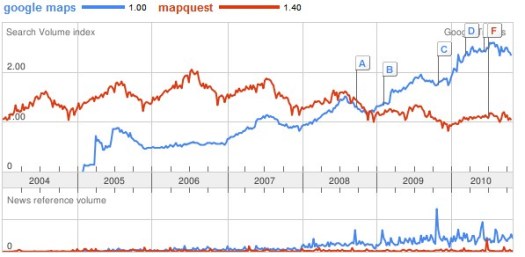
In mid-2009 Google Maps had just passed Mapquest. It was also pretty apparent that Google Maps was growing whereas Mapquest was slowing down. Well today it’s clear that Google Maps has beat Mapquest. The only real question now is if Google Maps has peaked or if it’s just hitting a temporary peak.
Norton versus McAfee versus Nod32 versus Kaspersky (half accurate prediction)
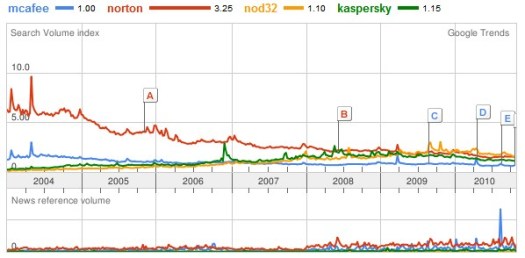
I predicted that Norton and Mcafee would continue to lose marketshare and Nod32 and Kaspersky would continue to grow. Unfortunately the trend graph is very hard to read because Norton had such a strong lead in the past. However if you take out Norton from the graph, it’s a lot easier to see the differences.
That being said, it’s still evident that Norton and Mcafee are declining (hence the mostly accurate prediction). However what’s unfortunate is that Nod32 and Kaspersky seem to have peaked. I then looked at “antivirus” and it seems to also be on a decline as a whole, which is intriguing. Therefore I don’t know if this is related, but it would be interested to follow-up and see what’s going on. Is it the industry in general that’s on a decline? Is it the economy? Or are there other upcoming antivirus companies replacing them? I don’t know and I just don’t have the time to research it myself, but I would definitely be interested to know.
Network Solutions versus GoDaddy (good and easy prediction)
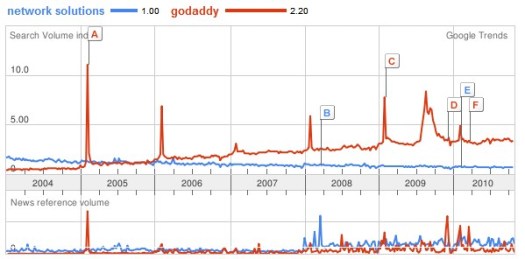
As predicted, the trend continues. Network Solutions continues to decline and GoDaddy continues to grow. I wish I could compare investments made in both of these companies but they aren’t publicly listed. In any case, I predict Network Solutions will continue to decline with time and GoDaddy climb.
SSD versus HDD (good and on track prediction)
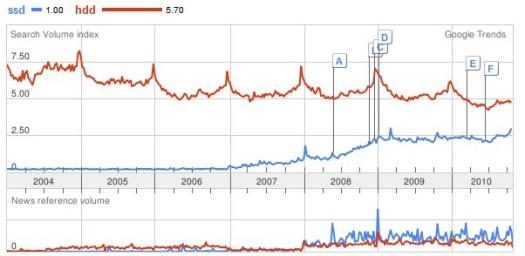
As some of you know, I’m quite biased when it comes to SSD versus HDD. I’ve been an SSD convert since early 2008. I currently have an Intel X25-M Gen2 SSD drive in my laptop. I will never go back to HDD’s. The difference is just staggering! Once you go SSD you can never go back to HDD!
Anyways, based on the Google Trends in mid-2009 I predicted SSD’s would eventually overtake HDD’s and eventually become the standard. Not just because I’ve seen the difference firsthand, but also because of the Google Trends charts. Well it appears that this trend is definitely continuing. I predict it’s only a matter of time before we see SSD’s overtake HDD’s. And once that happens, it will stay that way forever. The only thing holding back SSD’s right now is pricing, there’s still too much of a premium that most non-techies are willing to absorb. But as the prices go down, the trend will only increase in speed.
New Predictions
PS3 versus XBox
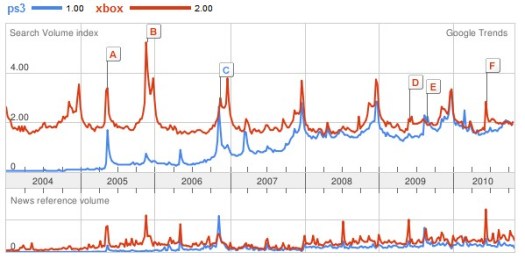
Based on the above Google Trends, I believe the PS3 is going to become the dominant gaming console in the next 1-3 years, at least until a new “disruptor” console comes along (generally every 5 or so years). And in case you’re wondering, I tried a few variations of the keywords XBox, Xbox 360, Playstation 3, and so on, and basically kept the main two keywords used for searches on these two consoles.
Digg versus Reddit
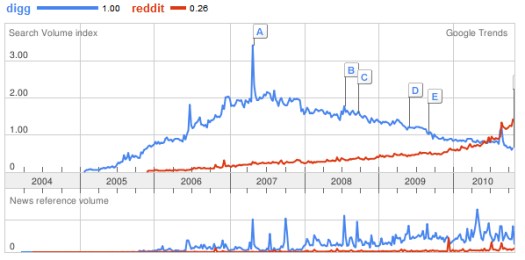
Looks like Digg has lost it’s way and is going to just keep on losing. Whereas on the other end of the spectrum you have Reddit which seems to be growing even faster since Digg’s recent issues.
Internet Explorer versus Firefox versus Chrome
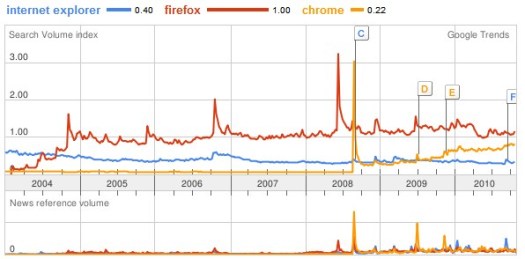
We’ve all heard news about IE (Internet Explorer) losing dramatic marketshare to Firefox. But how many of you have heard about the latest web browser from Google called Chrome? It’s first official public release was Dec 2008, less than 2 years ago. Although new, it seems to be growing by leaps and bounds while the other two browsers are either stagnant or losing marketshare.
So how do searches on Google actually transfer to marketshare? Quite well it turns out according to Engadget and Ars Technica. Their data is pretty consistent with what we find on Google Trends. IE is consistently losing marketshare, which is why Microsoft is pushing really hard to get IE9 out. This is their attempt at getting back some of their old glorry from the IE versus Netscape win. Firefox seems to be pretty much stable right now, neither losing or winning any real marketshare. And then there’s Google Chrome. According to StatsCounter, Chrome usage has tripled in the last year! Yes, that’s right, tripled!
So what does this all mean? Well unless there’s a significant improvement in either Firefox or IE, then my prediction is that Google Chrome will become a major player in the browser wars. I wouldn’t be surprised if it takes first or second place sometime in either 2011 or 2012.
Conclusion
Although I’ve just compared a few items, the potential is endless! And from what I’ve seen, the accuracy can be surprisingly good. So good in fact that Google has created Google Flu Trends.

Basically what they’ve learned is that the trends for searches about the flu mimic the actual real volumes of flu activity. The biggest advantage with Google Flu Trends is that it’s possible to get the data quicker than the CDC. Yes, that’s correct! The CDC takes about 1-2 weeks to compile the latest data whereas Google can publish it in real time! The idea is that if there is a major spike in flu searches, Google can warn the CDC 1-2 weeks before they even know about a pandemic!
But what about other diseases? I quickly searched for stomach flues and gastros and the data seems to indicate yes. That being said, I will admit I didn’t search very hard to confirm this, but I do suspect it would be very accurate. Scarily accurate!
My next big leap, which I haven’t taken or tested yet, is can Google Trends be used to predict elections? I highly suspect the answer is a resounding yes. I just took a snapshot of the Google Trends for the bigger candidates of the 2008 US presidential race and it clearly shows Obama leading his opponents in searches. Of course this is in retrospect, so it’s very easy to say after the fact. But what about the next election?
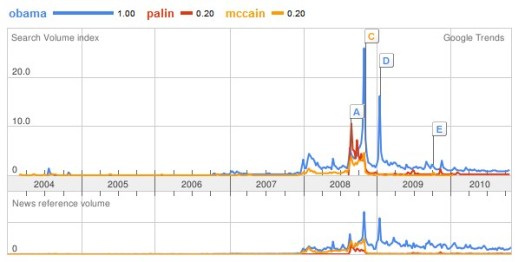
I can only imagine what else is possible. If you have any ideas, and especially if you find interesting trends and comparisons, please let me know. I look forward to seeing what you find!!
(good prediction)
Permalink to this article Discussions (2)
How To Really Know if Your Idea is Good or Bad

You’ve just come up with what you think is an amazing idea. A new business that will change the world. A new business that will make you lots of money! You quickly go out and share your idea with your friends and family and they confirm how good the idea is. Everything looks great! The world is perfect.
Then you set off to build your idea. You spend hours, days, weeks, months, maybe even years building it. Then you release it. Nothing happens. The streaming hordes of customers you expected don’t materialize. You can’t get any sales other than that first sale from you mom or dad, but that’s about it. Why? What happened? Everyone confirmed it was a great idea when you shared it with them…
The unfortunate reality is that almost all the time your friends and family will confirm your idea is good, even when it’s not. Firstly most people don’t want to rain down on your excitement. And secondly most of us have learned that delivering bad news is not fun, especially when it’s really not necessary.
So what I suggest, instead of JUST asking your friends and family if your idea is good, ask them if they would also purchase it.
Again, same as before, most will say they would. That’s good! That’s one step further. But don’t stop there. Many people will say yes but would never actually purchase it.
The next step is to confirm your idea by asking if they will purchase it now!! You’ll be surprised at how quickly things change once you ask them to commit real hard earned dollars (excluding your parents of course). Basically as soon as you ask someone to pay money instead of just giving positive wishes, you get their real views on whether or not you’ll succeed.
If you can’t get anyone to commit money to your idea then it’s very likely not a good idea. Maybe it’s too specific and you don’t have like minded individuals, but if that’s the case should you be pushing so far out of your core competencies in the first place. For example, if you don’t know anyone or anything about the kennel business, then should you really start a kennel business?
Getting back to the topic at hand, the only real and sure fire way to tell if an idea is a good idea or not is to ask people to pay for it. Not just if they would pay for it, but to actually ask them to pay for it. Your results will tell you just how good your idea really is!
Permalink to this article Discussions (4)
Should Software Companies Charge for Technical Support?

I personally believe that technical support for most software should be free, especially if it’s the result of poor software, of buggy software, or even just badly designed software. There are a few exceptions of course, but overall I don’t believe software companies should charge for technical support. To be quite frank, in a lot of cases it’s a conflict of interest, plain and simple. Especially if the the technical support is a profit stream for the company!
Let me give you an example. I’m going to compare my company LandlordMax which sells property management software (also known as real estate rental property software). Most of my competitors (without naming names) charge hourly for technical support (upwards of $200/hour). My company absolutely does NOT charge for any technical support. So why do most of my competitors do? Because this is a big source of revenues and profits for them.
To be quite frank, none charge a an understandable amount like $20-$50 an incident, where the goal is really just to recover the costs of offering the support. Rather most of my competitors will charge per the hour or require a minimum yearly support contract. The worse one I know of requires a minimum support contract can be up to 75% of the purchase price – in other words, you almost pay double the listed price for the software in support, and it’s required (you cannot purchase the software without the support contract). I don’t know why it’s like that in my industry, or how it got that way, but it seems to be pretty common. And I absolutely don’t agree with it!
So why is this bad in the first place? Why is this a conflict of interest? Well if charging for technical support is a profit stream for them, wouldn’t resolving ongoing issues, improving the usability of the software, fixing bugs, etc. be against their best interest. Sure they have to achieve a minimal level of sales, but after a certain point it can quickly become much more profitable to charge people to help them use your software than to acquire new customers. Especially if their data is locked in. You see in my industry, changing software solutions often means either re-entering all your data or starting from a clean slate, which is not what you want for managing real estate (your history is very important).
It’s so rampant in the real estate rental software industry (charging for support) that many companies have gone so far as to also charge significant amounts for training. Now I can appreciate that for some software solutions you will require training, but I can’t see how managing properties is one of them. At least not for all classes of your customers. I can see why some assistance may be required for a networked office with a team of people using it. But a small property management company or an individual real estate investor probably shouldn’t require extensive training. But that’s just my opinion. After all, what do I know about the industry, I just run one of the top property management software companies.
Without naming names again, I can tell you that for one solution I tested I couldn’t even figure out how to create a building and tenant to setup them up with a rent. I had to revert to reading the user manual, and even then it wasn’t perfectly clear, I had to fiddle around a bit. And this was a bigger player at the time (some years ago). Incidentally, they’re pretty much on their way out now.
But it’s not just support and training, what about documentation? Something to remember is that writing documentation such as a user manual, online help, FAQ’s, etc. does cost money. I’ll be the first to attest that our online documentation isn’t perfect, and we’re definitely working to improve it. Nonetheless, it’s better than most of our competitors right now.
And to be quite honest, as a company you provide documentation for several reasons, not all of them altruistic. Firstly to help your customers learn your software. Secondly to help them discover things it can do that they weren’t aware of. But you also leverage your documenation to reduce your support costs. That is to say, that for every person that can find the solution on their own on your website, that’s one less support request you have to handle. That’s one less support request you have to pay for. So it’s to your advantage to improve your documentation.
Now if you charge for technical support, where you not only just make your costs back, but where you actively make a nice profit, where is the motivation to improve the usability of your product? Where is your motivation to improve your documentation? It’s partially there, so much as you can get sales. But to truly maximize your profits you would probably want to make your documentation just good enough to get the sale but not good enough for the customer to figure things out on their own later so that they have to pay for support. That would be the optimal setting in such a setup.
Everything said, please bear in mind that I’m not advocating that all companies who charge for support are out to make money from you. In most cases they aren’t. What I’m against is companies that make bigger profits from charging for technical support. As soon as you turn your technical support into a profit stream, you’re basically setting yourself up for a conflict of interest. It’s unfortunate, but that’s just the way it is.
Like a proud parent (and as a disclaimer), I also have to take a second to brag about my company LandlordMax. So if you’re not interested in our metrics please do skip to the last paragraph. With a lot of hard work, we’ve been able to almost eliminate our support costs for existing customers. What this means is that almost all our support requests are pre-sales. Questions asking if the software can do this or that, which in most cases the answer turns out to be yes.
Generally once someone has purchased LandlordMax, they don’t contact us for further support, they’re completely self-sufficient. I’d say that 90+% of our support requests from existing customers can be categorized into two groups. They’ve either bought a new computer and want to transfer their data from one computer to the other, or they’ve lost their license information and need us to re-send it. Rarely do we get support requests otherwise. It’s all pre-sales, people asking for more information on what the software is capable of. Which tells me where we need to improve the most (yes, the website – which by the way we’re on the verge of releasing a major website update in response to this).
And just in case you’re wondering which types of solutions I would recommend charging a minimal cost for, to at least cover your own expenses of running support, would be software offerings such as an operating systems (you can’t control the crazy stuff people do to their computers), a system that requires a high level of technical skills (like setting up a server, a network system, a database, etc.), a system were the users can script part of the program, etc. Basically where it’s no longer self-contained. Where it could no longer be classified as shrinkwrap software.
Permalink to this article Discussions (10)
A Quick and Simple Way to Improve Your Productivity in Under One Second!

The quick and short answer, disconnect your internet cable from your computer for at least a day. You will be shocked at just how wired and distracting the internet can be!
Sometime last week our internet connection was lost due to a cut wire in the ground. Needless to say, it took a few days to get everything back and running. But what I learned over that time is how much more productive I was without the internet!
I’ve always believed myself as very productive and efficient in what I do, wasting very little time to unwarranted distractions. What I never really realized before is just how many interruptions the internet has to offer. Not necessarily in terms of me wasting time surfing, but the notifications, popups, and all other things that try and grab my attention.
First there’s email. I generally only check every few hours, but now I had no reason to check at all. I had no emails to respond to. Nothing. That sure freed up a lot of time. Now I wouldn’t offer this as advice to follow on a daily basis, but if you need a specially productive day, few days, etc., then just disconnecting completely from email can have a large impact on your productivity. And it’s not just the time lost task switching, it’s also the time it takes to read and respond to your emails.
After email another common problem is web browsing. Basically without an internet connection you can’t take a quick five minute surf break that accidentally ends up being a lot longer. I know when I get pretty tired I just fire up my web browser and check Hacker News, my Google Reader feeds, and so on. It does refresh me a bit, but not nearly as much as stepping away from the computer for a few minutes. Plus you never accidentally lose more than a few minutes if you don’t surf.
And it’s not emails and web surfing, if you don’t have an internet connection you can’t have a chat client open. You can’t have a twitter client open. You can’t take a quick peak at the weather, the news, etc. Basically you’re forced to focus on your work and nothing else. If you’re tired you get up and take a break, otherwise you’re focused on accomplishing your work.
Of course this doesn’t mean you should just be heads down working, everyone needs to come up for a breather once in a while. Take some 5-15 minute breaks when you’re tired. Do stop for lunch. Do get up when you need a break. The key is that you’re limited in what you can and can’t do, forcing you to better focus on your work at hand. Try it for a day, you might be surprised at how productive that day is. I definitely wouldn’t do it every day, but once in a while it’s a really good thing. Especially with looming deadlines!
Permalink to this article Discussions (2)
The Sunk Cost Effect

There are many many many many many books that teach you how to make money, but almost none that show you how to avoid losing your money. I personally had never really thought about this, at least not until I read the book What I Learned Losing A Million Dollars (an amazing book that I strongly recommend). Like everyone else, I was more concerned about making money rather than about how not to lose it. But as Jim explains it, there are many ways to successful make money but few to lose it all. You can invest in opposite strategies and still make money! The key to long term wealth is to understand the psychological forces that induce us to lose our money, even through our best efforts.
The book What I Learned Losing A Million Dollars starts off with Jim’s personal story of how he quickly climbed up the success ladder and then in a matter of a few months lost his entire wealth. What’s most interesting about the book is that what happened to him could happen to anyone. But the scariest part is how fast it can happen. It’s not that he did stupid things or spent wildly, it’s that he got caught up in a psychological trap. One that we all fall prey to from time to time, just on smaller scales.
Once it was all over for Jim, he went on a quest to find what the best investors did. What he found is that there was no consistency, they were all over the place. Many of them contradicted themselves and still succeeded. This lead him to question how this was possible, after all in most cases when two people use the opposite strategy one person has to come out ahead at the expense of the other. That’s how the markets work.
What he found out was that this wasn’t necessarily true. What happens is that successful investors know when to stop, when to drop an investment. Investors using opposite strategies aren’t always in the market, they’re in the markets at different times. They know when to wait on the sidelines until the markets favor their strategy. They don’t fall prey to as many psychological traps as ordinary people do. That is the only common thread he was able to find for highly successful investors!
And today we’re going to discuss one of those very common traps. It’s the effect of looking at your previous costs in determining whether or not to go forward today, otherwise known as the Sunk Cost Effect.
To give you a common example unrelated to investing, just to show how prevalent and strong this effect is, let’s take the example of car ownership. Let’s assume you own a car that’s a few years old (still pretty new) and you’ve just spent $2000 in repairs on it a couple of months ago. Suddenly this week it starts misbehaving, you bring it to the garage, and find out you need to spend another $1000, $2000, or even say $4000 on it. What do you do?
The best answer is to look at the value of the car TODAY and determine if it’s worth it TODAY. However, and this is where we almost all fall prey to the sunk cost effect, is that we also look at the fact that we just spent $2000 a couple of months ago. We’ve already spent that much money on it, so we might as well go forward with the new repairs. We don’t want to lose that $2000 in repairs from a couple of months ago. We may even rationalize that what we fixed a couple of months ago won’t break down again for some time so the car is better for it. And that’s a big problem!
What happens now if in another month we get another bill for another $2000? Well you have to get the repairs, after all you just spent $3000-$5000 in the last few months. And then what happens in another couple of months if it repeats. Oh my god!! We just spent $5000-$9000, there’s no way we want to lose all that money and/or effort. And so the vicious cycle has started and we start to lose more and more money just because we didn’t want to lose that initial $2000!! Trying to avoid losing that initial $2000 repair bill has now cost us around $10,000, and it’s only going to get worse! If the car is a lemon, how long will it take for us to give up? If you think it was hard at $2000, imagine now at $10,000! The more you lose, the harder it gets to pull out!
And it’s not just with cars, it can happen with just about anything. It can happen with your job. You may have already committed 3, 5, 10, 20 years to this job. You may hate it, it may be paid below market rates, and so on. But since you’ve already committed so much to it, you’re probably less and less likely to quit with time. This is why people get caught up in jobs they don’t like for years and years.
With investing, in real estate it could be you’ve already spent so much money renovating a property that you now have to wait to sell it until the market recoups, losing money each month for years and years, possibly losing everything through bankruptcy to avoid losing that $10,000 you initial spent on renovations. In the stock market, it’s a stock you bought at too high a price that you’ll now hold onto until it goes back to at least it’s original price. The list goes on and on.
The reality is that we should always look at whether something is worth it as of today. Period. It doesn’t matter how much time or money we spent on it in the past, we need to look at how much it’s worth today. If you can do that, you will save yourself a lot of trouble and money!
And that’s what smart investors do. They evaluate an investment in terms of what it’s worth today, they don’t look at how much they’ve already invested. In other words, you should always ask yourself: If I wasn’t already committed would I invest into this today? If the answer is no, then you need to seriously consider getting out of your investment before you fall prey to this trap, otherwise it will be that much harder as your position gets worse!
Permalink to this article Discussions (1)
13 Bad Excuses For Not Starting Your Business
If Nick Vujicic from the video above can do it, to be quite honest, then you better have a really good excuse why you can’t. If you’re not interested and it’s not for you, then that’s different. But if you’re using any of the excuses listed below, then I’m sorry but we’ve all heard them before. We know them all too well. These are 13 excuses, NOT REASONS, most people use for why they can’t start a business. The reality is you can, you just don’t want to enough. Because if you did, you’d find a way. None of them are reasons, they’re all excuses. And today I’m going to dispel each and every one of them.
1. I have no time.
Seriously? I call BS on that one. Almost everyone, and I mean almost everyone, has some free time or time that’s wasted.
Do you watch any tv shows? Do you go to any movies? Do you watch any sporting events? Do you go the pub/bar? Do you go out for dinners? Do you hang out on the patio or have barbecues with your friends on the weekends? I understand everyone needs time off to relax and so on, but no one said it was going to be easy either. If you do the math, and really look at how you spend your days, I have no doubt you can find at least 10 hours a week. And everyone can find at least a few hours each week!
2. I don’t know how.
Here’s a big secret, no one else really does either. There is no manual to being an entrepreneur. We just figure it out as we go along. The more experience you have, the better you get at it. Just like anything else.
If you want to look at it another way, it’s like riding a bike. No one knows how to ride a bike on their first try. But if you don’t start trying you won’t learn. The same is true with swimming, dancing, learning a new sport, learning a new language, programming. Even using a cell phone. It wasn’t that long ago that most people would say they couldn’t use a cellphone, and now almost everyone has one.
And unlike in the past, there’s a lot more information out there today. You’re not limited to just your local library, you can order virtually any book from Amazon. And if you don’t have the money, you can always research everything you need online on the internet. There’s no end of entrepreneurial information out there. The fact alone that you’re reading this article means you’re already learning from the internet!
3. I don’t have the money.
And? Only a really small subset of companies actually require a significant amount of money to get going. There are many many many businesses that require very little money initially to get started. Sure IT based companies like software companies probably do require less cash (and instead require a lot more time) that a lot of other businesses, but don’t think that’s it. There’s lots of different businesses out there.
In all honesty, the problem is because most people think too big for their first company. If you really want to succeed, start on a smaller scale. Just like when you start driving a car. Is it smart to learn how to drive a car in a Ferrari or is it better to learn in a basic sedan? Do you learn to fly a plane by flying a 777 Jumbo Jet your first time in the air or do you start with a basic 2 seater plane? Therefore start a smaller business, something you can build up from, and go from there. Use the money you earn from your first business to build your second.
PS: Do you have an LCD tv? Have you taken a trip in the last while? What kind of car do you own? Do you go out to restaurants? Do you go to the movies? If you really want to, I’m sure you can find some money.
4. I don’t know where to start.
There is no perfect place to start. But like the saying goes, a journey of a thousand miles starts with one small footstep. You need to start and the rest will just happen. The biggest hurdle is generally just taking that first step. And don’t stop once you’ve started, keep going. That’s another major hurdle most people fall prey to. They get excited, take a few steps, and then basically just stop taking any steps. Don’t let that happen to you.
5. I’m too young/old.
Really? What’s too young or too old? If you’re reading this, then you’re neither too young or too old. Age is a perception thing, it’s really all in your mind. It’s not a valid reason.
6. No one will give me any money.
Fine, then start something else. This is back to #3, maybe you should start something smaller. Don’t try to fly a Jumbo 777 jet your first time flying. Just because no one will give you money for THAT SPECIFIC business, it doesn’t mean you have to stop everything. There’s more than one business in the world.
At the very least, you can look at starting a smaller idea. It’s the same as when you start your career. No one will hire you as the president or CEO of their company when you first start. You have to build up your career, establish yourself. Start with a smaller business and create a history of success.
7. I’m waiting for the perfect idea.
Good luck with that. You’ll be waiting forever. There is no such thing as the perfect idea. And to be honest, there’s lots of ideas out there. Executing on your idea, I would say, is more important than the idea itself.
8. What if I fail?
What if you fail? What’s the worse that can happen? As Tim Ferris put it in his book The 4-Hour Work Week, what’s the absolute worse that can happen if you fail? If you really think about it, it’s probably not nearly as bad as you think. For sure you won’t die.
And failure is not a bad thing. Of course you’d prefer to avoid it, but so what if it happens. Imagine if you had the same avoidance of failure with everything you did. How would you ever have learned to drive? And by the way you can die learning to drive! How would you have learned to ride a bike? How would you ever visit a foreign country? Learn a new language? Learn to fly a plane? Learn to dance?
9. I don’t have the skills or experience
Were you a professional driver when you first got your driver’s license? Where you a professional basketball player the first time you tried to play basketball. What about doctors? They have to start somewhere. Everyone has to start somewhere, including entrepreneurs.
Don’t worry too much about this. Early on you’ll make more rookie mistakes, but that’s part of learning. As time goes on, you’ll find it gets easier and easier. For example, how difficult was it when you first started driving? Did you make silly mistakes (while still surviving)? Did it take almost all of your concentration? Did you drive at full speed? Now how do you drive? Is it much easier? Now you’re probably not thinking about the details, you’re thinking more of your route (strategy) rather than how much to push on the accelerator and if you’re too close to the car in front of you (daily busy work). Those things become intuitive after a while.
10. There’s too much competition.
There’s no such thing as too much competition. A large number of competitors means the market is too segregated which means there’s no dominating player. That’s really good!
If there’s only a few big competitors, you’re in even better luck! The big guys are just as scared of you as you are of them. Once a company has become big, bureaucracy sets in and doing anything, especially anything innovative, becomes very hard. Which also means don’t try to compete with them head on where resources are the key to success, focus on where they can’t compete! Innovation, customer service, quickness of execution, and so on.
By the way, competition is a good thing. It’s much harder to be the first because not only do you have to sell your product or service, you also have to educate people about it. Personally I prefer only having to deal with one hurdle at a time.
11. I have to wait until everything is lined up just right
This will never happen. All entrepreneurs will tell you this is a pipe dream. You’ll never have everything perfectly lined up.
Now that doesn’t mean don’t plan and try to prepare beforehand, it just means don’t ever expect to have everything perfectly lined up to start because it won’t happen. And in all honesty, no business ever goes 100% smoothly. You just have to roll with punches and adjust as you go.
My favorite analogy, which I’ve taken from the software world, is the classic example of driving a car. When you drive, do you lock your steering wheel and move forward, or do you continually make small adjustments, turn when needed, and so on. If you locked your steering wheel, you probably wouldn’t even make it past your street. The same is true with business. Nothing ever lines up perfectly, you just have adjust as you go.
12. It’s just too risky.
Is it really? How risky is your job? With a business you have multiple clients whereas with your job you have just ONE SINGLE CLIENT. All your eggs are in one single basket. So if your one single client decides they no longer need you, or they can no longer afford you, you’re revenues (paycheck) goes to $0. With a business, if one client drops you because they themselves run out of money, it’s not the end of the world because you generally have many other clients.
By the way, if you run your own company, you know what’s going on. As an employee, you can easily be blindsided and laid off at any moment. And we’re seeing a lot of that today. You’re at the mercy of management, which means you may not know until the last minute. Not only that, but it’s possible you could lose your job just to improve a balance sheet for investors and nothing more. You really have no control of what may happen, nor are you always going to have knowledge of what’s coming.
13. I’m still working on my business plan
This is my favorite which I saved for last! I’ve seen too many would-be entrepreneurs working on their business plans forever, never to actually execute on it. It’s much much much easier to write a business plan than to start a business. Plus you don’t have to push through all the hard walls and issues you’re going to encounter when starting.
Common variations of this are people who move from business plan to business plan. People who endlessly try to perfect their business plan. People who work on the minute details of their business plan forever.
By the way, a business plan is really just to give you an idea whether your business concept is feasible or not. Don’t ever try to execute it to the letter, it will never work as written. What you’re doing is writing down your assumptions and projections, that’s it. As you develop your business, you’ll find where you made errors in your assumptions and projections, and you should adjust accordingly. Trying to force a business plan to life is a recipe for failure. It’s really more of an initial guideline, almost to force you to think about what you’re going to do before you do it.
You’ll also find that as you become more and more entrepreneurial, you’re less and less likely to write up a business plan. After you’ve run a few companies, you don’t need to go through all the detailed planning because you already have a good idea of what’s coming ahead. Plus, your business plan rarely survives it’s first encounter with real customers. But if you’ve never started a business, it’s a good place to start. Just don’t focus too much on getting it perfect, or ironing out all the details. The business plan’s goal is to help you develop your idea, not write it in stone. You don’t have to follow your business plan perfectly, no successful entrepreneur ever does!
Permalink to this article Discussions (3)
| « PREVIOUS PAGE | NEXT PAGE » |