
Why You Should Never Publish Anything Late at Night When You're Tired

I broke one of my own golden rules last night, never ever release or publish anything late at night when you’re tired. If you do the odds of making a mistake greatly increase. And unfortunately last night I broke this rule and a mistake did happen. Luckily for me the mistake was minor, but it helped to reinforce what I should have already known.
You see I published my latest blog entry How Much is it Worth to You? after midnight last night. Although I often stay up much later than midnight, I’ve been going to bed earlier in the last while to catch up on some much needed sleep. In any case, the issue is that I was tired and it was late for me that particular night. Normally in these cases I still go ahead and “publish” the article, but I set the “publish time” to be sometime the next day.
I do this because of several reasons, the biggest reason being that I’ll have had some time to rest and be more awake before it gets publicly released. In some cases I’ve had the time to rethink parts of my post and add more information, sometimes adjust the example, and so on. But overall it’s prevented me a few times from making silly and stupid mistakes.
Well last night I went ahead and pushed the publish button, deciding that I’d break my own golden rule just this one time. And this was my mistake!
Some of you might have noticed it, but I think I caught it before most of you did. What happened is that when I wrote the article I initially left the headline blank. I often do this because I couldn’t think of a good headline at the time I wrote the article. In these cases I just continue writing and come back to the headline later.
Last night I forgot to come back later and write my blog post headline. I left it blank. Above the title being blank, it also meant that my RSS feed subject line was blank. No so bad for a starting blog, but as you get bigger it will be noticed by more and more people. Like I said before, this was not a major issue, but it definitely brought the point of my golden rule home. Plus it’s better to fall and learn (or in this case re-learn) from smaller mistakes than from your larger mistakes.
And don’t think this doesn’t happen to large companies releasing major new versions of their software. To give you an example, early on in my programming career, long before I started LandlordMax, at least 10-15 years ago, I worked for a company where a short workday was 12 hours. And that included weekends (this alone has the makings of a DailyWTF written all over it). As you can imagine we were living in a perpetually tired state. Come release time there was even more pressure to work harder and longer hours. And I did, after all this was very early in my career and I didn’t know any better.
Well the obvious happened. Something eventually went wrong one day. Although I can’t remember the details any more, it’s all a big blur, but I do remember one major release that we’d been working particularly hard to get out the door. We’re talking barely enough time to go home to shower and eat at night (or should I say the wee hours of the morning), never mind sleep. Well eventually we made a mistake, and it was a bigger one. On release night, after what we thought was exhaustive coding and testing, we felt like the current release candidate was ready to go. We decided to release it. We were done. Phew. So we performed one last final build to run one last final test round on (remember this is a time before automated tests were mainstream). And we released it. Exhausted we all went home to catch a few hours of sleep.
Unfortunately within a few hours we were all called right back into the office. Our released version had a major bug. I wish I could remember what it was exactly, but I can’t. To be honest I suspect my brain has intentionally forgotten about it. In any case it was broken and customers were complaining. All hell was breaking loose.
Being already tired really didn’t help to resolve this issue quickly. But lady luck was on our side because it was a very simple mistake and we were able to fix it very quickly (I think it was something like the wrong language properties file was being picked up in the wrong build). So simple a mistake that had we released it in a waken state, well even in a just non-exhausted state, it would never have happened. As soon as we re-released it the phones stopped ringing and we were able to finally get some sleep.
Never ever release when you’re tired. But more importantly, had the issue been a complex or hard one to resolve we would have been in a lot of trouble. Having your development team completely exhausted trying to fix a critical and complex bug during a firestorm is an incredibly dumb place to put yourself into. Would you want to have triple heart by-bass surgery performed on you while you were in the middle of a heart attack by a surgeon who had slept only a few hours in the last week and was living completely on caffeine? Especially when there’s no need for it to be like this.
You can’t win every time, but stack the odds in your favor! Be smart about it. Don’t make my mistake. And you can be sure I won’t break this golden rule again, at least not for a very very long time.
Permalink to this article Discussions (5)
Affiliates – Part 2
In my last post I debated whether or not affiliates are worth it for merchant’s, or in my particular case an ISVs (Independent Software Vendor). I personally believe that they’re worth it, but it takes time and effort to nurture for affiliates to be worthwhile. In any case, I promised I would write a follow-up with more detailed metrics, so here goes.
And for those of you who haven’t read the last post, I concluded with the following tip: If you do decide to go the affiliate route, you’ll find that almost all of your affiliates will fit into two main categories. Those that have 0-1 sales and those that have many sales. To maximize your results from your affiliates I recommend you increase the commissions of your higher performing affiliates, those that prove themselves. This will make them happy and work even harder to get you more customers.
To give you an idea of just how true that is, here’s our sales graph from ShareASale listing our affiliate sales distribution. You’ll find that 86% of our sales went to our Top 10 affiliates as illustrated in the graph below. That’s a whopping majority of the sales!!!
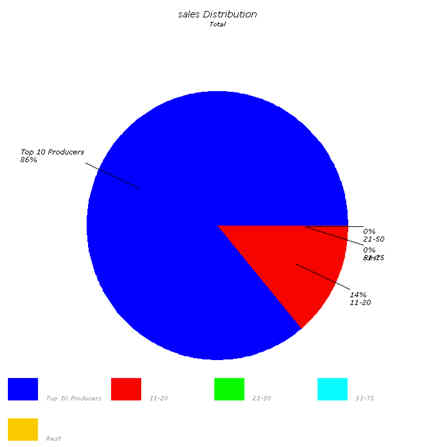
I apologize if the graph isn’t as clear as it can be, but the key thing to note is that the blue signifies the percentage of sales going to the Top 10 affiliates. It obviously dwarfs the rest.
Which made me think, can we get even more detailed metrics? Of course I could look at the raw data, filter it, and then generate my own chart, but luckily ShareASale offers a Bubble Chart of the top affiliates, which you can find below (I have left out the numbers and names of our affiliates for their privacy).

Looking at the above graph, it’s obvious that there are two super affiliates that bring in the majority of affiliate sales! I haven’t looked at the numbers in details, but I suspect they could count for half of all the affiliate sales. Following them there are two medium scale affiliates, and then everyone else. Therefore if we really want to maximize our results from our Affiliate program, we want to work closely with the top 2-4 affiliates. The others almost become noise. Not quite, you can obviously see that there are a number of affiliates getting some sales, but nothing in comparison to the super affiliates.
Which leads me to a bonus and unrelated last chart. I’m mainly posting it because I found it personally very interesting. But before I post it let me give you some context as to why I find it so interesting.
Before you purchase LandlordMax, you can try it for free for 30 days. And then, even after you purchase LandlordMax, you still have 30 days to get a refund if you’re not completely satisfied (for any reason). What does this all mean? Generally our customers have tried it before they decided to buy it, which is great (and I strongly recommend it). In other words they’re already comfortable with the software and know what they’re getting. They’re happy before they bought it. It also means we also rarely need to give out refunds. No company will ever not give out any refunds, but what I’m saying is that our number of refunds is almost non-existent.
That being said, when someone clicks on a link from our affiliates, they have 60 days within which to buy the software for our affiliates to collect their commissions. This gives them time to try the software for 30 days, as well as giving the purchaser time to ask for a refund (to protect us from fraudulent affiliates). Although rare, it balances out everything.
With that in context, below is the graph showing “Return days by gross sale amount”:
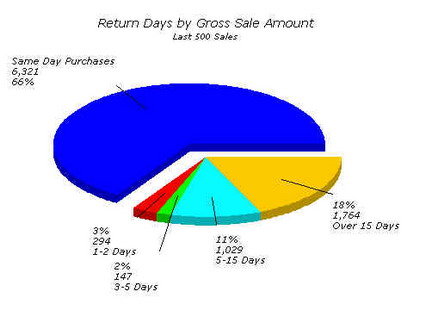
Notice anything? The majority of affiliate purchases happen on the same day that they clicked on the affiliate link! But what’s really astounding is that so far we’ve only had one affiliate refund (we actually had two but the second one was because someone accidentally purchased the software twice within 15 minutes). These are people who are buying LandlordMax the same day and not even trying it (sight unseen). This is very different than our internal sales cycle. I wish I could explain this but I just discovered it today when I was looking into the stats for this post. In either case, it’s very interesting and I plan to investigate it some more.
In any case, you now have an idea of what our affiliate sales metrics are like. Hopefully this will give you a better idea of whether it’s worth it or not for your company/website. Just remember that getting those super affiliates does take time, but when you find them they can make it all worth the effort.
Permalink to this article Discussions (6)
Are Affiliates Worth it for Merchants?
The real answer is it depends. Having an affiliate network to sell your product does require a decent amount of work, so if you’re going to do it the biggest tip I can offer is that you use a service such as ShareASales.com (which is what we use). Don’t try to roll out your own (we initial did), it’s not worth it. Going with a service will alleviate a lot of the technical effort and costs. You’ll still have many issues to deal with, ranging approving affiliates, dealing with people trying to scam you, etc., but at least your cost of running it will be drastically reduced. If we hadn’t moved to a service we would have dropped our initial affiliate program. Actually we were in the process of dropping it when I found ShareaSale.com. It just costs too much to maintain in-house.
In any case, an affiliate program can be worth it if executed properly. To give you an idea of what’s possible, since 2005 (so in two and a half years) we’ve sold $9,408.00 worth of licenses of LandlordMax through our affiliates. Although this might not seem like a lot, based on the amount of effort it took to manage the affiliates, the commissions($1,808.10), the amortized cost over all customers to build the software, technical support, etc. we believe we made some profit. In terms of percentage of total sales it only accounts for a small percentage, but it does add up to more than nothing. In other words it’s an extra $7,599.90 ($9,408.00 – $1,808.10) we wouldn’t otherwise have.
The biggest negative issue we encountered was an affiliate who generated a bit more than a dozen sales (not included in the above totals) that resulted in fraudulent credit card purchases. Luckily we were able to spot him pretty quickly, it was fairly obvious what was going on. Although I don’t know for sure what his intentions were, I would guess that he was trying to get paid the commission before the credit cards were returned to us as chargebacks. In any case we were able to quickly cancel all their transactions as well as avoid the chargebacks by being proactive.
That and some affiliates do use more “aggressive” means of getting people to your product. You should be on the lookout for these types of affiliates and try to limit them to what you find acceptable for your company. Remember that if they go a little crazy and spam your product all over the place (or at least more than what you find acceptable), your company will be associated with the spam, and not the affiliate! You need to be vigilant about these affiliates.
Because of all this we now manually inspect every affiliate that applies, and we double check all their purchases. However other than this negative experience it’s been pretty positive overall for us. The thing to remember is that managing your affiliate program does take time, so you need to add this into your cost. That’s above the commissions you pay out. So your average profit margin will be much lower than a regular sale, if any at all.
Where you’ll really benefit from affiliates is in the total lifetime of your customers, assuming you have a good product or service. In other words it might not even be a bad thing if they’re loss leaders, as long as these customers buy from you again (for example future upgrades as in our case).
So to answer the original question, are affiliates worth it from the merchant’s perspective? It depends. The honest truth is that you need to try it out and see what numbers you come up with. That and you need to look at the total lifetime revenue of your customer, not just that initial purchase, otherwise you’ll probably lose out. And expect to spend a decent amount of time managing and monitoring your affiliates.
Quick Tip: If you do decide to go the affiliate route, you’ll find that almost all of your affiliates will fit into two main categories. Those that have 0-1 sales and those that have many sales. To maximize your results from your affiliates I recommend you increase the commissions of your higher performing affiliates, those that prove themselves. This will make them happy and work even harder to get you more customers.
Permalink to this article Discussions (1)
What would it cost to build this site?

Earlier this month there was a thread on Joel Spolsky’s BoS (Business of Software) discussion forum asking What would it cost to build this site. Of course it started innocently enough, with a simple statement:
We recently created a startup on which the website is an integral part. Customers rent our product for a specified time period. When you get right down to it, the required features of the website are no different than what would be required of a car rental web site.
Then came the big question:
My question is, what would a ballpark estimate of the cost be?? Again, the fully functional site would resemble a car rental company such as Hertz.com
This is a completely loaded question!!! There will of course be very large price fluctuations amongst the responses no matter who you ask, these requirements are too broad and open-ended. Sadly however I believe that none of them are near the “real” cost to build this website. I think the highest was around $150k if I remember correctly, with many saying that it could cost as little as a few thousand.
WHAT???
Honestly, to create a car rental service just like Hertz will cost a lot more than $150k. Thinking it will only cost a few thousand is insane. Sure you can say you will outsource it for a few thousand, but I can guarantee you what will come back won’t be what you expect. The price has to be reasonable. If it only cost a few thousand to successfully build this system, than all software, and I mean ALL software, would be outsourced. This isn’t the case. I have no doubt it cost Hertz a lot more.
It’s simple to over simplify how much effort is required to build a software application. So much so that the original poster chimes back in with:
There is just no way this would bet done under $10,000. As I said, the site is about 30 percent of what it needs to do. 5,000 lines of code, couple hundred manhours. The manhours are high as we constantly were changing things. But things are a bit more static now and it would be easier to write a detailed spec for he the remaining requirements.
Some additional “Major” components:
Security/Logins. Certain Admin people will be able to do everything. Lower levels will have limited capabilities.
Audit trails for all changes by personnel. If someone changes a record or changes a reservation it needs to be logged.
RealTime Inventory Management. If inventory is low at certain times then site needs to prevent reservations from taking place. Also ensure inventory was the right stuff when it is returned.
Again, think rental car website. I was thinking more along the lines of $50K to $150K.
Just reading these specs I can very quickly see this site greatly increasing in complexity and scope as the details are filled in. Never mind that the scale of users or data hasn’t even been taken into consideration. In any case, I personally don’t believe that this is possible for $150k, it way too optimistic. The vast majority of the posters are thinking of the simplest solution, but I can already see from this slightly “enhanced” description that it’s not going to be the simplest solution. The requirements are only going to grow, and grow fast they will, otherwise known as scope creep in the software industry.
But alas not everyone agrees. Further down someone comments:
I dunno ’bout 100K. My devs do quite a bit of these sites in the $20K to $50K range … but we don’t have a tight enough spec yet do we? Could (maybe) hit the 6 figures once the full spec is known. The folks suggesting a couple of grand, though, they’re smokin’ crack.
Even though this person agrees that building it for a few thousand is too cheap, he still suggests a price that’s way too low. I have no doubt it cost Hertz much much more. I agree that a simple car rental system could be built for around $100k, but that’s a SIMPLE AND MINIMALISTIC car rental system and NOT a replication of a full blown car system as is suggested. Audit trails, realtime inventory management linked to reservation system, reservation system, scheduling, etc. And these are just listed as “SOME” additional “MAJOR” components. This is not a simplistic system. It will grow in scale very quickly. Just look at some of the questions and issues that came up when we decided to add “simple” email to LandlordMax. And that’s just simple email!
So what’s going to happen. The person will eventually settle on someone who says they can build it for around what they think is reasonable. The delivered system either will not work at all, it will be severely delayed, or it will be severeled scaled back in terms of features and modules. Not only that, but assuming something is delivered, I doubt that it could scale up in terms of traffic load. At least not at that price, scalability takes skill and experience, not to mention effort.
And I haven’t even talked about bug fixing! What do you think happens when a software project can’t possibly be delivered within it’s deadline? Depending on how ethical your company, they might just deliver it in an unstable state where “fixes” will be added to the cost of the project after delivery. For example some software consulting firms are know to do this, deliver a project “on time” only to have the “support” costs be higher than the initial project costs. This way they can be the lowest bidder but yet still charge the real cost of implementing the software. And don’t think it doesn’t happen, it’s much more prevalent than you might think.
Software takes time and effort to build. It’s not that simple yet people continue to grossly underestimate the cost of development and wonder why things it’s late, why it’s buggy, why it just doesn’t work. The answer is simple, extremely simple, many many software projects grossly underestimate the amount of effort required. Although many people want to believe it’s more complex than that, it’s really just as plain and simple as that.
Permalink to this article Discussions (2)
How to Generate Traffic to Your Website – Mark Gladding Review
Mark Gladding founder of the company Tumbywood Software which sells the software Text2Go, a nice little program that will convert almost any text to audio, reviewed my ebook How to Generate Traffic to Your Website. You can read Mark’s full review of the ebook by clicking here.
Some of the highlights of his review include:
The book is based on Stephane’s experiences over the last few years of marketing and promoting his software company online. This makes the content highly relevant to myself, as I strive to improve the marketing of my own software product Text2Go. I found the examples and statistics quoted in the book fascinating.
The material would also be relevant to anyone starting a small online business, not just a software business. I’m sure the issues are the same. Limited time, little to no marketing budget and 100 tasks all competing for your attention.
Stephane covers an impression range of traffic generation techniques in his book, the highlights being SEO, content generation, freebies, blogging, Google Adwords, press releases and social networking.
I found each topic was covered to just the right level of detail. As you can imagine, separate books could easily be written about each of the above topics. However when running a small business you don’t have the time to become an expert on every possible online marketing strategy. Stephane provides enough information on each topic to get results. Each of the major topics also includes excellent references to more indepth sources of information.
Stephane’s writing style is clear and easy to follow. The writing is illustrated with plenty of interesting graphs and screenshots.
He concludes the review with:
In conclusion, How to Generate Traffic to Your Website contains a wealth of really useful information that’s well organised and clearly presented. I can wholeheartedly recommend it to other small online software and non-software business owners. At $28.95 (or a couple of hundred Google PPCs) the ROI will be very quick.
Something else that’s especially interesting (this is not in his review but was communicated through emails) is that Mark converted the ebook to speech using his software Text2Go and listened to it on his iPod commuting to and from work. How great is that!!!
Permalink to this article Discussions (0)
Web Design for ROI – Review

I recently got my hands on a copy of the book Web Design for ROI: Turning Browsers into Buyers & Prospects into Leads. Overall I have to say it was a very good book, it really explained a lot of the key concepts in web conversions at a high level (sales conversions, lead conversions, etc.). For example I know our site isn’t perfect, and we already have a lot of work planned towards this end, but what I really liked is that most of the “enhancements” we’re planning for the future are described in this book. At least at a high level. This book is not about the details of the implementation, but it’s a high level description of what needs to be done and why.
Which is the key thing to remember about this book, it’s written at a high level, meaning it’s aimed at people who are newer to the concepts of website conversions (sales, leads, etc.). Therefore if you’re already well seasoned on concepts such as sales conversions it won’t be as exciting for you. It’s not as detailed or thorough as books like Call to Action, but it’s still very good. This book will be especially interesting for you if you’ve been mainly focusing your attention on traffic generation and ignoring any efforts on items such as sales conversions, etc..
I’d highly recommend this book for anyone who has a website where they’d like to increase their conversions, be it sales, leads, etc. It’s a good introduction and will get you going. What I really appreciated was the “Digging Deeper” chapter at the end. The authors really hand picked the best books and websites on the market to recommend as further resources to investigate. Personally I’ve almost read every single book they recommended, as well as follow most of the websites they recommended. Some examples of the books they recommended (which I’ve recommended – even reviewed – before here on my blog) include: Don’t Make Me Think: A Common Sense Approach to Web Usability, Call to Action: Secret Formulas to Improve Online Results, Blink: The Power of Thinking Without Thinking. And some examples of the websites they recommend include: Marketing Sherpa, Guy Kawasaki’s website and blog,
Overall I recommend this book, especially if you’re just starting to get into the market of increasing the performance of your website. It’s not as advanced as some of the other books out there, but that’s not it’s intention. It’s a great book to start with and build up from. Well worth the purchase.
Permalink to this article Discussions (2)
BitsDuJour Ebook Sale Results
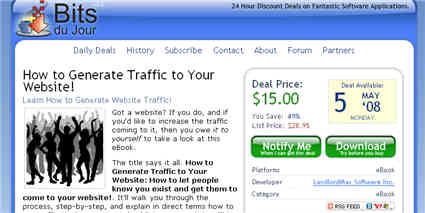
As many of you know from my post yesterday (or from seeing it directly), my ebook How to Generate Traffic to Your Website was showcased on BitsDuJour.com for the day. As part of being on BitsDuJour, I offered a 49% discount, bringing the book down to an even $15.00.
Overall the results were positive. I really enjoyed working with Roger (my contact) at BitsDuJour. He was very professional, helpful, and really made the whole experience a pleasure. Thank you Roger.
In terms of results, there was a noticeable spike in sales of the ebook. It wasn’t quite as high as I wanted, I was hoping to replicate Bob Walsh’s success from some months back. Nonetheless it was pretty decent. I was able to sell a 45 copies of the ebook in one day, which is good. It’s a bit shy of my personal target of 200 sales but acceptable (I always aim high).
I suspect one of the bigger reasons for the differences in sales volume is due to the topic of my ebook (as well as price). What I mean by topic is that there are a lot more traffic generation ebooks out there, and to be honest many are pretty bad or very weak on content. So I can understand people’s trepidation. But my book is about over-delivering and under-promising, or as to quote someone who attended the seminar I gave last summer “if most courses are like drinking from a water fountain, than in comparison this course is like drinking from a water hydrant!” I can’t wait to hear people’s responses once they’ve had a chance to read the book!
In any case it was a good day. Doing the math, the revenues comes out to:
45 * $15 = $675
Of course it doesn’t end there, we now need to remove the commissions and other obvious costs:
PayPal charges = $33.75
BitsDuJour commission = $256.50
Total Profits = Total Revenues – costs
$675.00 – $256.50 – $33.75 = $418.50 Profits
The real profits are slightly less, I had to do a bit of related customer support which eats into my time (I’m not free either). But for simplicity let’s ignore that and say the profits for the day were $418.50 which is pretty good. I’m happy.
What interesting for me is that above the revenues it generated, it also created traffic to my website. My RSS feed count went up a bit. It also gave the ebook a lot more exposure, and hopefully that will result in more reviews. If you’re one of the people who bought the book and you do post a review online, please let me know, I’d love to read it (positive or negative).
Another really positive thing that came out of being on BitsDuJour is that it pushed me to update my sales page for the ebook. I knew it had to be done, I even mentioned it here on my blog as being higher on my to do list. Knowing which day specifically I was going to be on BitsDuJour pretty much committed me to a deadline, which apparently I needed. So that was a really good thing if nothing else.
The big question, would I do it again? Absolutely. The exposure was great and the revenue was good. Most importantly though I really enjoyed working with the people at BitsDuJour, even after the deal had expired they continue to treat me very well!
Permalink to this article Discussions (5)
49% Discount – Today Only
The ebook I wrote (How to Generate Traffic to Your Website) will be on sale for $15.00, a huge 49% discount from the regular price, on BitsDuJour.com. This discount will be available ONLY TODAY so if you haven’t already purchased it, nows a great time!
The book has gotten many great and raving reviews, of which you can find some of the highlights below. Above the highlights, you can also click on each of the reviewers signatures to read their complete and full reviews.
In addition to this you can read the first 21 pages here for free to see for yourself what the book is like. This sample of the ebook includes the full detailed Table of Contents and a decent portion of the first chapter on SEO (Search Engine Optimization).
Here are some highlights from the many reviews I promised:
It’s remarkably in depth. I’ve only read some of it so far, but what I’m most impressed with is the breadth of the coverage. It pretty much hits on everything someone starting a commercial website needs to think about.
As someone who knows a fair bit about these topics, I found Steph’s down to earth – here’s-what-you-want-to-do-and-why – presentation very complete. His chapters on SEO, AdWords and press releases were some of the best material from a microISV’s point of view I’ve seen to date. Steph pulls from both the experience of his microISV – LandlordMax – and other sources to illustrate and illuminate his points.
The SEO chapter in particular is must reading for any microISV because it focuses on techniques that work today – not 5 years ago – and because it gives you for the time invested a solid set of strategies to start acting on now. MicroISVs seldom have the luxury to dive to the bottom of any of the many subjects we have to deal with.
[…] To my surprise I found that Steph has done an indepth analysis of the traffic generation process and the sheer volume of topics covered in the ebook itself, reveals the amount of research Steph has done to accomplish this book. […]
Honestly, each section and category in itself could’ve easily made into another E-Book and believe me there are lot of e-books out there which deals with only 1/220th of what Steph’s written about in thie ebook, but sells for a higher price.
Steph’s done an amazing job on this ebook, and his hardwork is very evident from the research done, the topics and the sheer depth of information present on each topic.
I can assure you that this is NOT an ebook that will contain information that you’ve already read elsewhere.
Every page is simply worth the money you pay. And it’s cheaper that all those “I’ll teach you everything in two minutes” kind of books. […]
[…] Stephane has actually put a lot of work in the book, making it very easy to read, simple to find what you’re looking for and packed with some serious information about driving traffic to your sites. […]
We consider ourselves pretty savvy, but Stephane’s book has made us look at a few of the methods descibed from a different angle. We’re not saying its all new and revolutionary, we’re saying its got everything you need to know to start increasing your traffic, drastically. […]
Besides tons of written information, Stephane has also made sure that visual examples are placed throughout the book, to make sure you know what he’s trying to teach you. […]
Stephane absolutely knows what he’s talking about, and a lot of this is also coming from his personal experiences as a webmaster. We’ve got nothing bad to say – in fact, looks like we’re going to have to redo our own ebook in the making.
But the selling point for me to get this eBook was the fact that it wasn’t like all those spammy-type eBooks out there. It gives you realistic and proven tips for the long run, rather than the short term deal. Again, the fundamentals that people often overlook. Matter of fact, I have seen quite a few eBooks and all of them tend to only be a few pages long, but not How to Generate Traffic to your Website. This eBook goes into so much depth that it tries to fill as much information within the 138 pages. And so far, every single page has been useful information for me.
So, for all of you guys looking to make money online, you need to build traffic to your site first and foremost and I’m going to go on record and guarantee that this eBook is going to help me in more ways than one.
One of the highlights of the book for me was the sense of balance and perspective that is shown. For example, it’s possible to endlessly tweak your Adwords campaigns or your onsite SEO. However, Stephane repeatly emphases the point that you need to look at the ROI of your time. I also think the fact that he’s not advocating a single traffic generation technique means that he’s not afraid of recommending you weigh up each technique when deciding on how to make your next improvement. One really useful tip he makes is to play to your strengths. For example if you write great content for your blog and you enjoy it, then do more of that rather than trying to become an expert in another technique such as Google Adwords.
[..]In conclusion, How to Generate Traffic to Your Website contains a wealth of really useful information that’s well organised and clearly presented. I can wholeheartedly recommend it to other small online software and non-software business owners. At $28.95 (or a couple of hundred Google PPCs) the ROI will be very quick.
Don’t wait, today’s a great day to bring the traffic to your website to the next level by buying the ebook How to Generate Traffic to Your Website. You won’t get a better price, and it’s only available today at this amazing 49% discount of $15.00. You can buy it right here and now by clicking here.

Permalink to this article Discussions (3)
How to generate traffic to your website – Dat Money Review
Jason from DatMoney.com very positively reviewed my latest ebook “How to Generate Traffic to Your Website” earlier this month. If you haven’t had a chance to come across it yet, here are some of the highlights from the review:
“I mean, we all can’t know everything; we have to start from somewhere, right? And although my methods do help build traffic, just by reading the first 30-40 pages of this eBook, I was in shock on how much I have missed out on.”
Further on he states:
“But the selling point for me to get this eBook was the fact that it wasn’t like all those spammy-type eBooks out there. It gives you realistic and proven tips for the long run, rather than the short term deal. Again, the fundamentals that people often overlook. Matter of fact, I have seen quite a few eBooks and all of them tend to only be a few pages long, but not How to Generate Traffic to your Website. This eBook goes into so much depth that it tries to fill as much information within the 138 pages. And so far, every single page has been useful information for me.”
However the best recommendation is that he “goes on the record and guarantees” the ebook is going to help you:
“So, for all of you guys looking to make money online, you need to build traffic to your site first and foremost and I’m going to go on record and guarantee that this eBook is going to help me in more ways than one.”
Thank you Jason for such a glowing review! And it’s great to hear you got a lot of value out of it.
You can read the first 21 pages of the ebook for free here, which also includes the full Table of Contents. The ebook costs only $28.95, and you can buy your own copy right now by clicking here.
Permalink to this article Discussions (2)
More LandlordMax Sales Metrics
Last week I promised I would post a follow-up article to my previous one about our sales metrics at LandlordMax, where I would show our daily sales averages over a month. Well here’s the graph below:
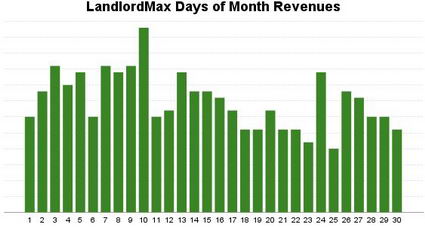
It’s not exactly what you would expect from a property management software application is it? To quote Eric, the founder of RentARoom.ca, who commented on my previous post (thanks Eric):
“Beginning of the month is probably slow, rising to mid month to it’s peak, and the last days of the month fairly low sales as well. The slowest days: First to Third of the month.
I guess property managers are busy trying to get it all done in their old system. They give up by mid month, or catch their breaths and say they have to find an “easier” way by next month and find a new program.
So by that, advertising just before mid month would be best. (depending on first ad seen -first visit to the website- and conversion to a buying decision)”
That was exactly my initial thoughts. And this proves why it’s so important to get real hard data rather than assuming. In this case common sense is wrong, including mine. The best days for our sales are at the beginning of the month, when landlords and property management companies are at their busiest.
Not only that, but when they’re at their quietest time is when we get the least sales. In other words when we expect the most sales is when we’ll get the least!
Why is the real buying pattern almost the opposite of what we’d expect? Although I don’t know for sure and I can only speculate, my guess is they buy LandlordMax when they’re experiencing their biggest pains. That is they buy it when they need it most rather than when they have the most time. The biggest time for sales is when all the rents are due.
Interesting isn’t it? Common sense in this case proves to be wrong. Getting cold hard data made a real difference, it was very educational. It’s also a very big reminder to always double check your intuition with data. I’m sure glad I did!
Permalink to this article Discussions (4)
| « PREVIOUS PAGE | NEXT PAGE » |